Viridia

Once, “green” meant something simple.
It meant leaves unfurling in spring. Moss covering stone. Ferns languishing in the shade. New grass after rain. The skin of a pear turning from hard and bitter to sweet and ripe. It meant life, growth, and the astonishing diversity of the natural world.
Today, the word has become something else.
Green mining. Green aviation fuel. Green energy. Green growth. Green development. Green consumerism. Industry, governments, NGOs, and advertisers have stretched the word so far that it has nearly lost all meaning. A word that once described the brilliance of sun shining through new leaves in the forest is now attached to strip mines, data centers, airports, and industrial supply chains. The purpose is obvious: if people care about nature, then nature’s language must be appropriated and attached to the machinery that destroys it.
The word “green” has been so abused and misused it is now not verdure—the color of life—but the color of lies, aggrandizements, and obfuscations. Through repetition and propaganda, industrial activities are clothed in the moral authority of the natural world. The mine, the factory, the airline become green. The Machine itself becomes green.
Nothing has changed except the language.
This abuse of language matters because words shape perception. When every industrial project can be described as green, how can it mean the color of life, of forests, meadows, wetlands, and thriving ecosystems? Instead green becomes a vague symbol of virtue, detached from the reality of living beings.
Perhaps the word is too damaged to recover.
I think we need a new word, and I propose viridia.
Viridia is not merely another name for green. It is the color of life made visible.
Viridia is the spectrum of living landscapes. It is the thousand subtle shades found in woodlands, marshes, gardens, mountainsides, and coastlines. It is the color-signature of flourishing ecosystems.
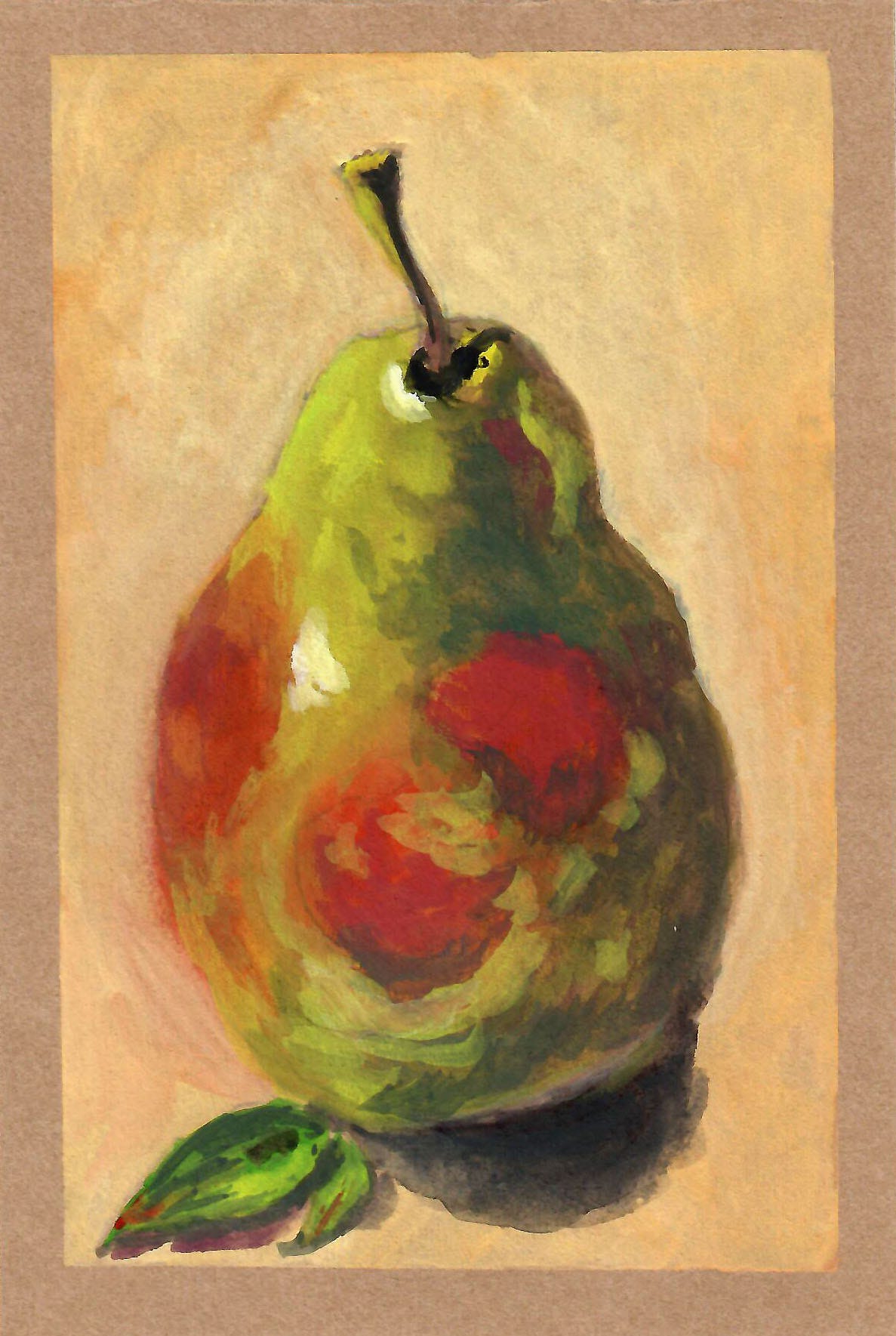
I was reminded of this while painting a pear.
At first glance a pear seems green. Yet the moment one tries to paint it, the illusion vanishes. There is no single green. The surface contains yellow-greens, blue-greens, gray-greens, olive-greens, muted greens touched by ochre and sienna and crimson, luminous greens touched by gold. The shadows are not merely darker green but entirely different colors, like purple (with a hint of green). Some mixtures look artificial and lifeless. Others suddenly capture the living quality of the fruit.
A painter quickly discovers that nature is almost never the bright synthetic green that comes directly from a tube of paint or the green used in the propaganda for “green” industry.
The living world is subtle.
To paint a pear well requires careful observation and patient mixing. One must learn to see beyond the simplified category of “green” and perceive the richness that actually exists.
The same is true of our relationship with nature.
Modern industrial society sees the world in abstractions. Forests are timber resources. Wetlands are drained for development opportunities. Grasslands are cattle food and carbon offsets. Living communities are units of economic production. In the same way that a child might describe a pear simply as green, industrial civilization reduces the living world to simplified categories and metrics for profit.
The natural world is not a uniform green backdrop against which human activity unfolds. It is a tapestry of relationships, textures, colors, forms, and ecologies accumulated over millions of years. Every natural community possesses its own character, its own expression of life.
Viridia names that reality.
Unlike “green,” viridia cannot describe a mine, an airport, or a marketing campaign. It refers only to the visible presence of living nature. A hillside may possess viridia. A forest may shimmer with viridia. A wetland may overflow with viridia. But no amount of advertising can manufacture it.
Green has become a brand, a certification, a technology, and a signal of virtue that obscures the unwillingness to do anything to protect the natural world.
Viridia is the color of life made visible.
We are saturated on a daily basis with words and images that dissociate us from reality, and green has become one of those words. Instead, we need words that point us toward reality rather than away from it.
For centuries we have expanded the vocabulary of commerce, finance, industry, and technology. Meanwhile our language for the living world has withered almost entirely away. We possess hundreds of words for economic growth and most humans now know only a handful for the qualities of a thriving landscape.
Words act as compass; place-speech serves literally to en-chant the land, to sing it back into being, and to sing one’s being back into it. —Robert Macfarlane, Landmarks
Two books with prominent places on my bookshelf, books I take down to look at often, are Landmarks and The Lost Words, both by Robert Macfarlane. They describe the rich language we humans used to have for the intricacies and varieties of the natural world, thousands of words disappeared and disappearing from our vocabulary, mirroring the destruction of the natural world. Even entire languages that are built from the natural world (like Gaelic) are disappearing, too.
In The Lost Words, Macfarlane writes:
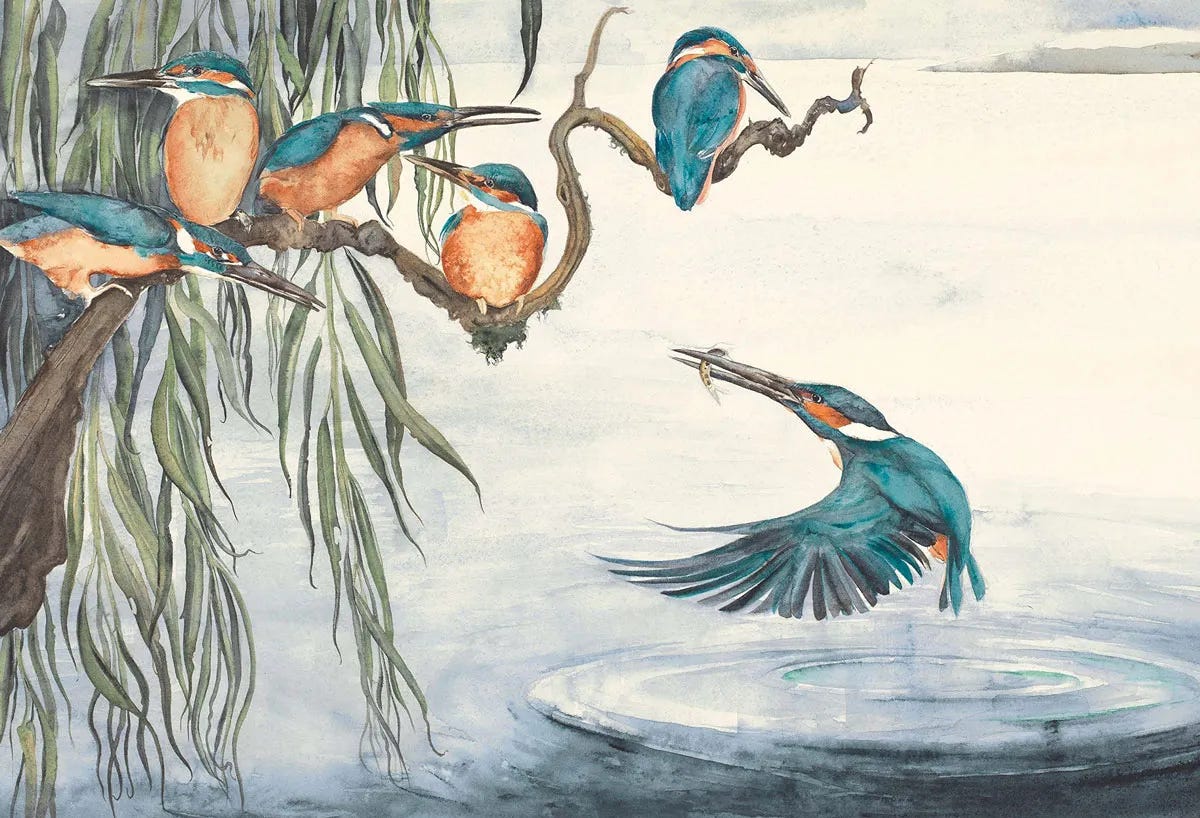
Once upon a time, words began to vanish from the language of children. They disappeared so quietly that at first almost no one noticed—fading away like water on stone. The words were those that children used to name the natural world around them: acorn, adder, bluebell, bramble, conker—gone! Fern, heather, kingfisher, otter, raven, willow, wren… all of them gone! The words are becoming lost: no longer vivid in children’s voices, no longer alive in their stories.
Macfarlane and artist Jackie Morris created The Lost Words in response to their erasure from the Oxford Junior Dictionary, replaced by words like cut-and-paste and broadband.
To recover our relationship with the natural world, we need to recover our ability to see it and to describe it. There are plenty of words already out there we can use if we are willing to dig through the dustiest of library shelves and used book stores for old dictionaries and books like Landmarks and The Lost Words.
But we may also need new words to replace those that have been stolen from us.
Viridia: the perceived color quality of living nature; the color of life made visible.
Color: “a deep viridia”.
Quality: “the viridia of the forest”.
Measure of ecological vitality: “this landscape still has so much viridia”.
Related words: viridian, a brilliant green pigment that is a hydrated oxide of chromium (Merriam-Webster).
Etymology: viridis (Latin), meaning primarily green, but also fresh, youthful, blooming, flourishing, vigorous.
When reading your thoughtful essay, I couldn't help but think of Hildegard of Bingen's extensive use of the term veriditas. From an herbalists perspective, it is the greening power within a person and within nature. Some people turn brown, wither, and need to have their veriditas healed. Hildagard would prescribe the color green for improved veriditas and instructed patients to go stare at a green meadow, or forest as what we look at can heal, or harm us. Which ties into nature vocabulary disappearing from a child's lexicon, as what we see impacts the words we know and our perspectives. Because most folks don't think through the lens of viridia/veriditas, we're a spiritually sick culture.
I'm a foraging instructor and have taught both adults and children to identify various trees and I've found that viridia can be cultivated within minutes. If it is of interest to you, I wrote about it here: https://divinenature.substack.com/p/redeeming-our-ancestral-awe
Two years ago, on turning 60, I got my first tattoo Viriditas with ivy vines accentuating the greening power of this word. Hildegard is a true icon of longevity and the blending of the natural world with the spirit.