
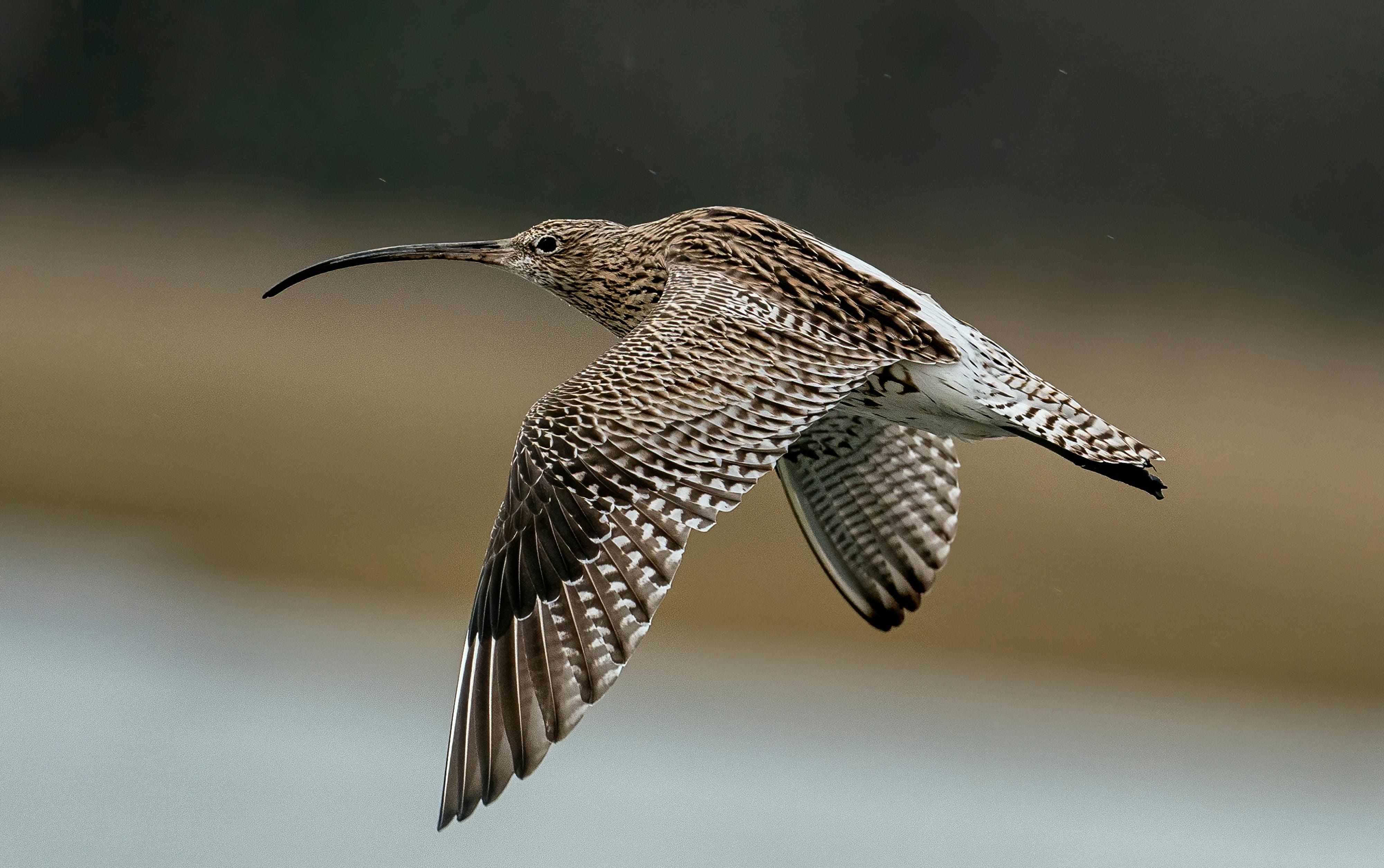
There is a particular kind of environmental loss that isn’t a single catastrophic event, like a fire, a flood, or a species declared extinct on the evening news. Instead, it’s a slow recalibration of what counts as normal, happening so gradually that few notice or experience the whole of it. Ecologists call this shifting baseline syndrome: the tendency for us to accept the ecological conditions of our own childhood as the reference point for “normal,” even when that starting point is already a diminished remnant of what came before.
Few books that I’ve read illustrate this process as well as chapter 3 of Farley Mowat’s Sea of Slaughter (1984). The chapter is titled Swiftwings after the Eskimo curlew, a shorebird who migrated in numbers so vast they were once described as darkening the sky, and who today is considered critically endangered and probably extinct. Mowat’s chapter is a heartbreaking description of a vanished bird and the cruelty that caused the bird’s probable extinction. The chapter is also a case study in how abundance disappears and how the memory of abundance disappears right along with it.
Numbers with no experiential reference point
Mowat describes curlews arriving on the Eastern seaboard in concentrations that read, to a modern eye, almost like myth.
As late as 1966, an old Inuk living on the shores of Franklin Bay could still tell me what it had been like when pi-pi-piuk returned from whatever distant and unknown world had claimed it during the long winter months.
“They came suddenly, and fell upon us like a heavy snow. In my father’s time it was told they were so many on the tundra it was like clouds of mosquitoes rising in front of a walking man. Their nests and eggs were in every tussock of grass. At the end of the hatching moon there were so many of their young scurrying about it was as if the moss itself was moving. Truly they were many! But when I was still a child, they were few. And one spring they did not come.”
— page 61, Sea of Slaughter
A birder today might get genuinely excited over fifty shorebirds in one place; a hundred in a single flock would be an exceptional sighting worth reporting. Mowat is describing a world where the relevant unit of measurement wasn’t the bird, or even the flock; it was a mass extending across the visible landscape.
This is shifting baseline syndrome in its purest form: our current idea of “a lot of birds” is not a neutral observation. It is the residue of years of disappearance, inherited as if it were simply how things are.
Abundance as its own justification
The horror in Mowat’s account isn’t only the killing; it’s how psychologically easy the killing was, precisely because the birds seemed limitless.
According to a nineteenth century account, “their arrival was the signal for every sportsman and market hunter to get to work, and nearly all that reached our shores were shot.” Such enormous numbers landed on Nantucket Island one autumn in the 1840s that the supply of shot and powder was exhausted and, to the disappointment of the residents, the butchery had to be “interrupted.” — page 66, Sea of Slaughter
The birds’ own social behavior compounded the disaster. Shorebirds circled back toward wounded companions instead of fleeing, which meant a single hunter could fire again and again into the same flock.
In the 1770s, so Captain Cartwright noted in his journal, a hunter could count on killing 150 curlews in a single day with only the crude muzzle loader of those times. A century later, Labrador hunters with improved firearms were routinely killing thirty curlews at a shot. Most fishermen kept loaded guns in their boats and on their fishing stages, “and shot indiscriminately into the great flocks as they wheeled by. — page 64, Sea of Slaughter
This exposes a flaw in human reasoning that persists today: we allow abundance to become the justification for exploitation. If there are so many, surely a few thousand can’t matter. And then, eventually, there aren’t so many and the logic that permitted the killing evaporates only after there are none left to protect.
Scarcity is what follows from abundance being treated as an inexhaustible resource rather than a living natural community with limits.
Mowat’s book describes how people regularly competed to kill the last of a species, to grab the last few specimens for their own fame and fortune:
As the curlews became rare in life, so did their “specimen” value soar. Scientists began to compete fiercely with each other to acquire the skins of those few that still remained… By 1919, the skin of a swiftwing was worth $300, and with such a price on their heads the few remaining survivors had little chance. In 1924 and 1925, the last two individuals ever to be seen in the province of Buenos Aires were both collected for Argentina’s Museo Nacional de Historia Natural. — page 73, Sea of Slaughter
Scarcity increases the value of something, feeding the desire to have it. This is as true for rare specimens of wildlife as it is for rare books and one-of-a-kind shoes. Ostensibly, we here in the U.S. now have the Endangered Species Act (ESA) to help protect a species when its numbers become scarce, but in reality, the ESA does little to actually protect wildlife, and—now—almost nothing to protect the habitat wildlife need to survive.
When the baseline shifts within a single lifetime
What I find especially unsettling about Swiftwings is the rapidity of the Eskimo curlew’s decline. Some declines aren’t spread across centuries, but happen in stages, compressed enough that a single observer could watch the whole arc:
Millions → thousands → hundreds → dozens → single birds → none.
Someone who grew up watching thousands of curlews pass overhead comes to think of hundreds as a small flock. Their own children, who only ever saw hundreds, grow up thinking fifty is a good day’s birding. Their grandchildren, who only ever saw fifty, treat a single curlew as a wonder worth traveling for. And their great-grandchildren don’t see the bird at all, and have no particular reason to notice its absence.
The first chapter in Mowat’s book, about the mass slaughter of the great auk, is a similar story of compressed extinction. Reading his book, I often wonder about the species we never even knew who disappeared before we humans could ever record their existence.
Extinction has a second stage: forgetting
We usually think of extinction as a biological event: the death of the last individual. But there is a second, cultural extinction that follows it: the extinction of memory. The Eskimo curlew’s decline happened fast enough that people who had witnessed the immense flocks were still alive when the species had become, for all practical purposes, gone. As U.S. Fish and Wildlife Service materials note, there’s been no direct evidence of nesting since 1866 and no confirmed sighting since 1963, though, notably, the species has not been formally declared extinct. The IUCN still lists it as “critically endangered, possibly extinct.”
That unresolved status is, in its own way, the most haunting detail in the whole story. The curlew exists in a kind of limbo; neither confirmed present nor confirmed gone. The bird’s disappearance from public memory is proceeding faster than the species’ disappearance from taxonomic possibility. Somewhere, someone could in theory still see one. But almost no one is looking, because almost no one remembers there was ever any Eskimo curlew to look for.
Imagine someone born today along the curlew’s old migratory route. They don’t experience an absence. They don’t scan the sky wondering where the birds went, because as far as they know, there were never any Eskimo curlews there to begin with. There is no felt loss when the reference point disappears along with the beings themselves.
Two kinds of killing
It’s tempting to tell the curlew’s story as a single mechanism—either pure slaughter or pure habitat loss—but Mowat’s chapter makes clear it was both, operating together, and it’s worth pulling the two apart before putting them back together.
The birds were killed directly everywhere along the curlew’s migration. Mass slaughter of curlews happened on U.S. Midwestern prairies, during the birds’ spring migration north when curlews stopped to feed on the plains in the same enormous, densely packed flocks that made them so vulnerable everywhere else along their route:
“During the [spring] flights the slaughter of those poor birds was appalling and almost unbelievable. Hunters would drive out from Omaha and shoot the birds without mercy until they had literally slaughtered a wagonload of them, the wagon being actually filled, and with the sideboards on at that…. [W]hole loads of the birds would be dumped on the prairie, their bodies forming piles as large as a couple of tons of coal, where they would be allowed to rot while the hunters proceeded to refill their wagons with fresh victims and thus further gratify their lust for killing. The compact flocks and tameness of the birds made this slaughter possible and at each shot usually dozens of the birds would fall.” This kind of butchery, be it noted, was done solely in the name of sport! — pages 70-71, Sea of Slaughter
But the birds weren’t only being shot out of the sky. Their survival also depended on an intricate, continent-spanning supply chain of habitat: Arctic tundra for breeding; vast curlew berry heaths (yes, named for the Eskimo curlews) in Labrador and Newfoundland to fatten up for their journey south; prairie stopovers for feeding; and South American wintering grounds for the rest of the year, with different food sources critical at each stage, including tundra berries and, crucially, the eggs and nymphs of the Rocky Mountain locust.
The locust story is almost too on-the-nose to be real. The curlews depended heavily on locust eggs during their prairie stopovers. Then agricultural conversion of the grasslands—plowing and fire suppression—destroyed the habitat both species depended on. The locust, once swarming in the billions across nearly 200,000 square miles, went extinct in its own right by the early twentieth century. U.S. Fish and Wildlife Service materials are explicit that hunting alone can’t account for the curlew’s collapse; habitat conversion and the loss of this keystone food source compounded it.
Both things were true at once, and that’s the point. The direct killing was removing birds from the population faster than they could reproduce. The indirect destruction—the plowed prairie, the suppressed fires, the vanished locust—was simultaneously removing the conditions any surviving birds would have needed to recover. Together, these disasters closed off any path back.
A species can be exterminated by a gun, or it can be exterminated without anyone ever intending to at all and often both are happening at once. Plow the prairie. Suppress the fire regime. Drain the wetland. Bulldoze the berry heaths. Fragment the insect populations the food chain depends on. No single actor has to pull a trigger for the second kind of killing to work. The birds arrive, one migration at a time, in a world that can no longer support them.
This is the real bridge from Mowat’s history to the present, because a great deal of today’s ecological damage looks exactly like the second kind: a road, a subdivision, a pipeline corridor, a mine, a monoculture field, a pesticide application, a clearcut. Each individual action looks isolated; nobody sees it as connected to the road, the subdivision, the pipeline, the mine, the pesticide application, the clearcut happening elsewhere, all of them chipping away at the same whole. The animal only experiences the cumulative result.
However, it would be a mistake to let that diffuse story stand in for the big picture, because it risks implying that the era of deliberate mass killing—the main subject of Mowat’s chapter—is safely behind us. It isn’t.
In the United States, Wildlife Services, a federal program run by the USDA, kills over a million wild animals every year: coyotes, foxes, bears, wolves, beavers, birds, and occasionally protected or endangered species caught as “non-target” casualties. This mass slaughter is largely at the request of the ranching and agriculture industries, on the premise that these animals are a nuisance or predation risk. It operates with comparatively little public oversight, using traps, snares, and aerial gunning, and its own data show the toll running into the hundreds of thousands to millions annually depending on the year.
Separately, and legally in most U.S. states, wildlife killing contests award cash and prizes to whoever kills the most, the largest, or occasionally the smallest of a target species—usually coyotes, sometimes bobcats, foxes, or prairie dogs—over a single weekend, with no bag limit. Wildlife biologists broadly agree these contests don’t “manage” populations or protect livestock; participants and organizers mostly acknowledge the appeal is the competition itself. As of the mid-2020s, only around ten U.S. states have banned these slaughter-fests.
Then there’s the sage-grouse, a bird whose population has fallen roughly 80 to 90 percent from historic levels, and whose decline federal biologists themselves documented as warranting Endangered Species Act protection back in 2010. The sage-grouse still isn’t listed. The listing has been repeatedly deferred, first for “higher-priority species,” then withdrawn on the strength of voluntary state conservation plans, even as monitoring in the years since has continued to show the population declining. We are watching human rapaciousness for more of everything drive the sage-grouse extinct even as we acknowledge the decline, document it, and do nothing, for reasons that have more to do with land use and political economy than with uncertainty about the bird’s trajectory.
Across parts of the Mediterranean—Cyprus and Malta most visibly, but not only there—illegal trapping and shooting of migratory songbirds continues on a scale that researchers have called industrial: mist nets and glue-coated lime sticks strung across acacia thickets, birds lured in with electronic calls, hundreds of thousands to over a million songbirds killed in a single autumn migration season in Cyprus alone in some recent years, much of it feeding an illicit market for a traditional delicacy. Enforcement has reduced the numbers from the millions killed annually a decade ago, but the trade persists, run in part by organized trapping operations.
Thacker Pass, Nevada, is a case study in this diffuse mechanism playing out as I write. The pass isn’t habitat anyone is trying to destroy for its own sake; it’s the site of what’s being developed as one of the largest lithium mines in the country, driven by demand for electric-vehicle and BESS batteries, and framed as part of the so-called “clean-energy transition.” The pass used to be a critical wildlife corridor linking two mountain ranges, prime greater sage-grouse habitat holding a meaningful share of the species’ entire global population, home to an endangered fresh water snail, and a pronghorn migration route that the mine has severed. Nevada’s own wildlife agency has warned of permanent impacts to the area’s wildlife and water resources. No one involved in developing the mine has sage-grouse, snails, or pronghorn in their sights. That’s precisely the point; it’s the plowed-prairie mechanism again, just wearing the clothing of a different, ostensibly well-intentioned industry.
None of this is the same as what Mowat describes. Perhaps fewer people today are shooting wildlife for sport by the thousand than during the period of intense hunting documented in Mowat’s Swiftwings. However, it’s a mistake to treat Swiftwings as a story about a uniquely brutal past that modern sensibilities have simply outgrown.
The mechanisms are still active, running in parallel: the indirect killing that happens through habitat destruction that nobody intends as an attack on any particular species, and the direct, sometimes fully legal and sometimes illegal killing that continues because the systems permitting it—economic, institutional, and cultural—haven’t been dismantled. Shifting baselines make both harder to see. The diffuse kind disappears into infrastructure and doesn’t look like killing at all to most people. The direct kind, when it’s legal or officially sanctioned, disappears into bureaucratic language—“predator control,” “nuisance management,” “traditional practice”—that makes it sound procedural rather than what it is: mass murder.
Adaptation as a liability
Flocking in immense numbers was an evolutionary success strategy for the curlew. It worked, for millennia, against every predator the species had ever encountered. Until humans. Once humans arrived with clubs, nets, firearms, railroads, and a commercial market for game birds, the same behavior became fatal. Their density made them easy to locate. Their cohesion meant a single volley could take hundreds at once. Their instinct to circle wounded companions turned rescue behavior into a killing mechanism.
An adaptation that functions beautifully within one ecological system can become a fatal vulnerability the moment a single species radically rewrites the rules of that system. This is a useful way to think about human beings as something categorically different from an ordinary predator. A wolf doesn’t wake up one day with a spear, a net, a club, a rail network, a firearm, or access to a distribution market spanning three continents. Human technology doesn’t just add a predator to the food web; it changes the arithmetic of every interaction downstream.
Knowing and killing
Mowat quotes ornithologist A.C. Bent condemning the destruction of the Eskimo curlew, and then notes that Bent himself had killed tens of thousands of birds, curlews among them, in the name of sport and science:
“One need not look too far to find the cause which led to the destruction of the Eskimo Curlew. On its breeding grounds in the far north it was undisturbed. And I cannot believe that during its migrations it was overwhelmed by any great catastrophe at sea which could annihilate it… several other birds make similar, long ocean flights without disaster. There is no evidence of disease, or failure of food supply. No, there is only one cause: slaughter by human beings: slaughter in Labrador and New England in late summer and fall; slaughter in South America in winter, and slaughter, worst of all, from Texas to Canada in spring.”
So wrote Dr. A.C. Bent, dean of American ornithologists in the 1920s. His was a verdict that must have taken some courage to express since the good doctor had himself killed tens of thousands of birds, including Eskimo curlews, both in pursuit of sport and in the name of science.
— page 61, Sea of Slaughter
This is shifting baseline syndrome’s less-discussed cousin: the gap between knowing something is disappearing and acting as though it isn’t. Bent wasn’t ignorant. He could articulate, in writing, that the species was in trouble, and continue participating in the practice causing the trouble. That’s not a contradiction unique to the nineteenth century. It’s a pattern that shows up constantly in the present: we can hold accurate ecological knowledge and continue behaving as though the underlying system is inexhaustible, because the consequences arrive on a timescale too slow to feel urgent. The sage-grouse know exactly what this means.
Who are today’s Eskimo curlews?
Which natural communities do we currently call “a healthy population,” “a normal river,” “a full forest,” or “an intact habitat” only because we’ve lost the reference point for what those communities were like before? Shifting baseline syndrome isn’t a historical curiosity limited to nineteenth-century shorebirds. It’s an active, ongoing mechanism shaping insect populations, salmon runs, old-growth forest cover, large-mammal ranges, native grasslands, amphibian diversity, and marine biomass right now, in real time, all over the world, and largely unnoticed because noticing requires a reference point most of us don’t have.
This is, for me, the real lesson in Swiftwings: the syndrome isn’t just about forgetting how many birds there used to be. It’s that we become steadily less able to recognize ecological impoverishment as impoverishment. A landscape with fewer insects, fewer predators, fewer old trees, and fewer wild places doesn’t necessarily feel diminished if it’s the only landscape we’ve ever known; it feels complete. The diminished community becomes, in turn, the baseline against which the next generation measures further decline.
That is the actual mechanism by which extraordinary abundance disappears without any single generation ever experiencing the full arc of the loss, each generation mistaking one slice for the whole picture.
Counteracting shifting baseline syndrome
If the mechanism runs on forgetting, then the countermeasure has to run on remembering… deliberately, since this remembering no longer happens culturally or automatically. I’ve come to adopt two practices to work against it, and neither requires special expertise.
The first is imagination. I live in the Salish Sea region of Washington State. Wolves were still present here into the late 1800s, before Hudson’s Bay Company employees slaughtered them on behalf of sheep farming interests. I try, sometimes, to actually picture that: not just knowing abstractly that wolves “used to be here,” but imagining the specific animal moving through this specific ground. I do the same thing with the landscape itself. Much of what surrounds me now is invasive grasses, a green that reads as “nature” to anyone glancing at it. So I try to imagine underneath it: the native wildflowers and bunchgrasses that grew here instead, the native insects who depended on those particular plants and no others, the birds who fed on those insects and on the seeds those grasses produced. It’s a small, deliberate act of reconstruction; building the baseline back up in my head, one layer at a time, precisely because the landscape can no longer do that for me.
The second is study. Learning the species who were actually here, and how natural communities assemble, shift, and depend on each other over time, is what makes the first practice possible at all. I can’t imagine the wolf or the wildflower I don’t know existed.
This is also, I think, the real antidote to the shifting baseline problem. A landscape stops looking complete the moment you know what’s missing from it. That knowledge doesn’t undo the loss. But it does restore the capacity to see the loss as loss, which is the one thing shifting baseline syndrome is specifically designed to take away.
People from all over the world visit Washington State, including the place I live. I think about how we don’t see the incomprehensible loss we have caused to the natural world whenever I hear tourists exclaim, “It’s so beautiful here.”
Yes, it is. And this place, like all others, is a mere shadow of what it used to be.
On Shifting Baselines:
For me, it's coral reefs. The Florida keys was stunning in the early 1970s and I am sure as a 17 year-old what I was seeing was already degraded compared to earlier decades. Now, 98% of the corals are dead in the Keys. Same thing, for inshore reefs in Kenya, and I suspect pretty much everywhere. Solomon Islands and Raja Ampat were still quite good for inshore reefs in places in 2016-2019, but bleaching and damage were obvious, so unless you did SCUBA, you had a hard time finding really healthy reef.
I was recently in Zanzibar (Feb 2026), and a group of us paid to go snorkeling on what we were told was the best reef in the area. It was completely dead, but fish feeding and a little dead structure attracted hundreds of colorful fish, all generalist species. The neophytes were happy with it. So many pretty fish! Let's have a beer. It was one of the saddest places I have experienced.
Powerful, poignant and sobering. & "Mother Earth calls to her children / you are all related is the ingredient / without it / yo won't know who you are." John Trudell. Spoken word piece with wolves
https://www.youtube.com/watch?v=62_64pmU5sg&list=RDdvH6OodW7VE&index=4