

Whenever I write an article for one of my local outlets about degrowth or cutting back on energy use or asking why we cannot seem to have a discussion about these things, I’m ignored or derided. Called “Cassandra.” Told I’m not being realistic. Accused of being a NIMBY (I am a proud NIMBY!).
The most recent article I published got this response among others: “The history of the world is that it rarely goes back in time. Someday humans are possibly going to extinct [sic] from over development and over population, but the comp plan isn’t going to change that one way or the other.”
“The history of the world is that it rarely goes back in time.” This is demonstrably not true. Many civilizations have come before this (final) global one, and all have collapsed, fully or partially, with populations “going back in time” in perhaps every case.
The statement would have been true if the commenter had written: “The history of the world is that it rarely goes back in time intentionally.” People, with a few notable exceptions, like the Amish, generally don’t set limits on themselves. Civilizations tend to grow without limit, using up more and more of local “resources” (i.e. nature, including fresh water, soil, animals, trees, metals, minerals, etc.) until they exploit the environment to the point of collapse. In the past, people have reverted to simpler lives for a time, or gone out to conquer new lands and find new resources.
Now, there are no new lands to conquer, which is why we are currently living in the final civilization in history. This global civilization is exploiting the entire Earth to support itself; it is in catastrophic overshoot, and thus is lowering the carrying capacity of Earth for all species, not just our own, in a final blow-out party of exploitation and destruction.
A Long History of Going Backwards
Perhaps the first society of people we know of in history that went “backwards” were Cro Magnon societies in the Upper Paleolithic. As these early humans tamed fire and learned how to make better tools, they expanded into every continent save Antarctica. During this expansive phase, life was good. Mega fauna abounded on every continent, providing easy abundant food from prey who’d never before experienced a predator with tools and hunting techniques capable of killing hundreds at a time (driving entire herds of giant bison off cliffs, for example). These societies had ample time to create jewelry and art on the walls of caves because of this abundance.
However, our ancestors eventually exploited mega fauna to extinction, and then had to resort to hunting smaller mammals instead. During these Mesolithic times between Paleolithic hunter/gatherer societies and the agricultural societies of the Neolithic, the art and jewelry-making largely stopped. Humans were far too busy hunting small game, and transitioning to more gathering and scavenging, and less hunting, and didn’t have the luxury of extra time to make beautiful things.
In other words, they went “backwards,” as measured by the cultural values of art and leisure time.
Since this first historical collapse, there have been many more. The Mesopotamian empires—the Akkadian Empire, the Old Babylonian Empire, the Assyrian Empire, and the Neo-Babylonian Empire—all fell, at least in part, due to ecological decline. They deforested their regions and they irrigated the land intensively leading to salinization and failure of the soil, often leaving deserts behind. The collapse of these empires saw widespread destruction and the people of these societies went “backwards” losing literacy, cities, and trade networks, reverting to smaller, local, subsistence economies.
During the Western Roman Empire, Romans invented concrete and plumbing, and built aqueducts, long-distance trading routes, roads, and more. After Rome fell, these systems stopped functioning, and humans forgot how to make concrete. Literacy declined, cities shrank, and again, people returned to rural, subsistence farming, a time we call the Dark Ages in Western Europe.
This has happened over, and over, and over again. The Maya society collapsed. So did the Inca, and the Aztec, and China’s Dynastic empires, and on and on. In every case, the survivors of collapse went “backwards” to more subsistence living for a time.
There is no reason to believe the end of our own global civilization will be any different, although perhaps one difference may be the likely impossibility of any recovery, and even the extinction of humans (who knows?!).
Recent History
A more recent example of society going “backwards” is the collapse of the Soviet Union. 1990s Russia witnessed significant political and economic upheaval following the collapse. This period involved a transition to a market economy, along with widespread poverty, social unrest, and political power struggles.
The state that had guaranteed jobs, pensions, and social services evaporated almost overnight. Factories closed, wages went unpaid, and the currency melted away in a haze of hyperinflation. For ordinary people, survival became a daily improvisation. Bartering became a crucial mechanism for individuals and businesses to acquire essential goods and services, as the official monetary system faltered. Russia’s oil production plummeted drastically in the 1990s, falling almost in half between 1988 and 1998 with reduced government funding for exploration and production and foreign investors scared away by the faltering economy.
It is tempting for Americans to see those years as a uniquely Russian tragedy—an artifact of the Soviet system’s collapse. But if we look more closely, the dynamics that tore through Russia’s economy then are not so alien. They were, at root, the dynamics of a system running out of stability, out of surplus, out of the energy that kept it together.
The transition from a centrally planned economy to a market system, coupled with hyperinflation (reaching 2300% annually in the early 1990s) and attempts at economic stabilization, created a highly volatile environment for energy prices. After 1991, the ruble collapsed, and wages often arrived months late if at all. People quickly learned to spend their money the same day they got it, before prices doubled.
In Russia, collapse meant barter. Ordinary people traded vodka for medicine, shoes for heating coal, and jars of jam for school supplies. Companies paid their workers with products, which they could then sell or barter. Tire factory workers got tires. Tool makers got drills. Many were happy to be paid in fertilizer they could use in their gardens to grow their own food. Organized crime filled the vacuum, with mafia groups controlling everything from street markets to oil exports.
Perhaps the most jarring change in Russia’s 1990s was the explosion of inequality. A small elite—the “New Russians”—suddenly flaunted Mercedes cars, gold chains, and villas on the Black Sea. Meanwhile, male life expectancy plunged below sixty, driven by stress, alcoholism, and collapsing healthcare.
Russia’s collapse had environmental fallout too. Environmental protections in the U.S.S.R. were almost non-existent prior to collapse, and worsened in the 1990s with the lack of state attention. Forests were illegally logged by both desperate locals and criminal groups. Poachers ravaged wildlife for meat and fur.
Institutional Resilience is Fragile
It is tempting to assume that modern, and especially Western, institutions are inherently stronger than those of the collapsing USSR. In some ways, this is true: the West retains layers of formal authority, technical expertise, and decentralized governance.
Legal frameworks rigorously protect contracts and property rights, but often at the expense of the environment and broader social welfare, allowing resource exploitation that ultimately harms people, even if most do not realize it. Regulatory agencies possess specialized knowledge, but many are captured by the industries they regulate, weakening their ability to enforce rules or protect the public in times of scarcity. Courts, while formally independent, are increasingly polarized and subject to political influence, limiting their effectiveness during crises. Civil rights protections, too, are fragile: under pressure, governments usually restrict freedoms, criminalize dissent, and treat environmental and social activists as threats, leaving vulnerable populations exposed.
In short, Western institutions may offer partial resilience compared with the USSR’s abrupt collapse, but this resilience is selective and temporary. Structural authority may survive for a while, but the capacity to safeguard ordinary citizens, communities, and the environment will erode quickly under systemic energy and economic shocks. These institutions might slow the spread of crisis and provide some buffer, but they cannot fully prevent the social, economic, and environmental consequences of a systemic ecological, energy, and financial collapse. Fragile, politicized, and often co-opted, these institutions will fail to safeguard ordinary citizens, much as they already struggle to do under less extreme pressures.
The End of Recovery
By the early 2000s, global oil and gas prices skyrocketed. The combination of higher prices and renewed investment (both domestic and foreign) allowed Russia to restart development of existing oil and gas fields and bring previously marginal projects online. This increased production and export volumes, generating massive revenues for the state.
Russia, with vast reserves of natural “resources,” became a major exporter of fossil fuels and fertilizers. The influx of cash allowed stabilization of the budget, partial repayment of debts, and growth of domestic consumption. Under Putin, the government once again centralized authority, creating a more predictable, if authoritarian, environment for investment and economic activity.
It is tempting to believe that globalization, free market economies, and capitalism create economic stability in our modern times. However, these systems are dependent on ever-increasing growth and constantly improving technology to discover new reserves of minerals and metals and new ways to exploit nature. Infinite growth on a finite planet is impossible in the long-run, and with no lands left to conquer (except in the minds of the psychopathic billionaires who want to mine the moon, or Mars, or asteroids), and limited minerals and metals remaining to find and exploit, the collapse of our global economy will perhaps be the last collapse in human history. Future recovery, other than in fits and starts, is extremely unlikely.
What This Means for My Own Community
The commenter on my article wrote “Someday humans are possibly going to extinct [sic] from over development and over population, but the comp plan isn’t going to change that one way or the other.”
It is guaranteed that humanity will go extinct. Whether that extinction will be from over-development and over-population, or some other reason is yet to be seen. When we go extinct is also yet to be seen.
However, we can draw some conclusions about when life will get far more difficult for a relatively wealthy county like the one I live in, seemingly largely insulated from the ecological collapse already underway, with few understanding the impacts of the extreme inequality and poverty that exists in the county, and the catastrophic environmental degradation that has already occurred here.
Many people in this county are concerned about climate change, and as I’ve written about before, my local utility is pushing large so-called “renewable energy” projects because they are concerned about blackouts due to cable failure in peak demand events, and because they are required to by Washington State Law.
But climate change is just one of many crises we face in the polycrisis of overshoot, and probably not even the worst. Biodiversity decline due to habitat loss, pollution, and other factors may be what gets our species in the end, although obviously climate change is connected not just to biodiversity decline but the many other crises we face like ocean acidification, habitat loss, and more. Biodiversity decline, habitat loss, and pollution have been happening in this county for a long time, especially since settlement over a hundred years ago.
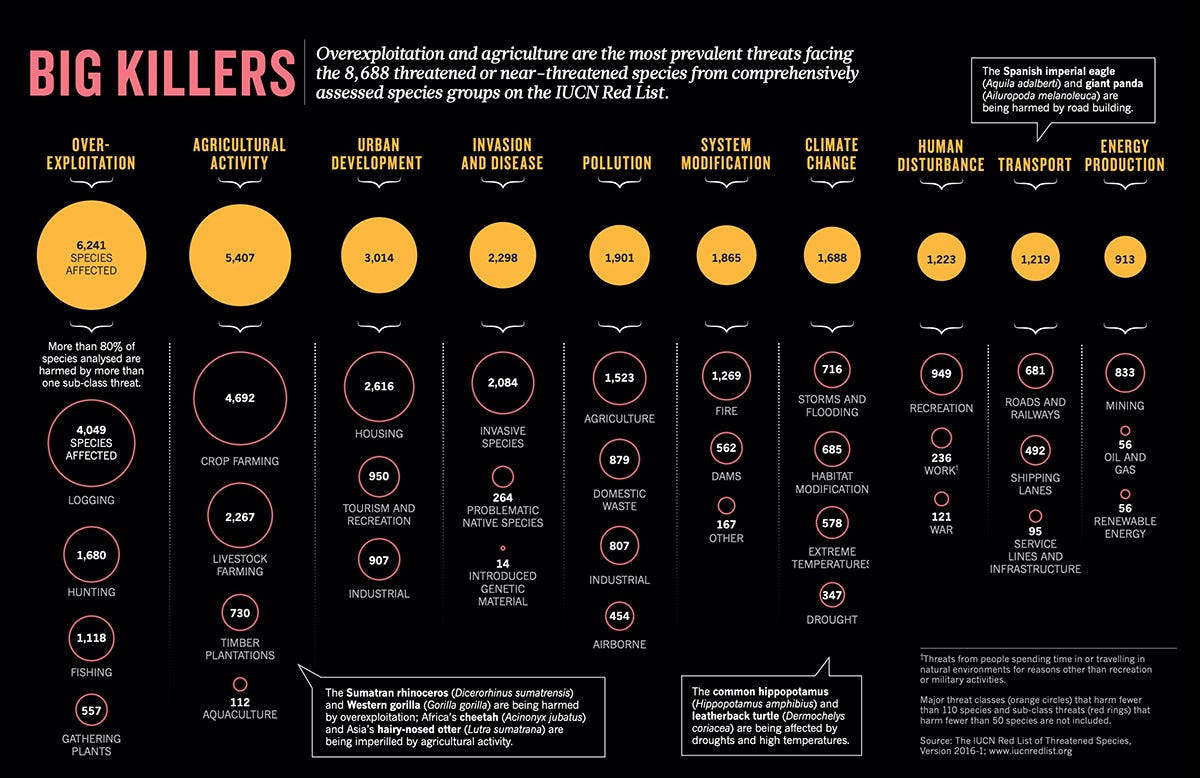
Continued global population growth, development, exploitation of nature and of minerals and metals, CO2 emissions, and more ensures that collapse is far closer in our future than many want to believe. A January 2025 report from the Institute and Faculty of Actuaries articulates the risk: “At 3C or more of heating by 2050, there could be more than 4 billion deaths, significant sociopolitical fragmentation worldwide, failure of states (with resulting rapid, enduring, and significant loss of capital), and extinction events.” (Quote from The Guardian article about the report.) The report considers only the impacts of climate change and not the impacts of the many other crises we face, so we can assume that the actual risk of total collapse is in fact far greater when factoring in pollution, soil loss and salinization, ocean acidification, desertification, drought, fresh water decline, biodiversity decline, species loss, habitat loss, and more.
Our comprehensive plan in this county will not change the global polycrisis of overshoot, or our long-term fate. That much is true. However, our own comp plan, structured around growth, and supporting the development of more energy in anticipation of more growth and demand within this county, simply perpetuates the ecocidal, utterly unsustainable lifestyle we live here, not just within the county but in our minds. As long as our comp plan does not acknowledge what we face, the citizens of the county can kick the can down the road and pretend all is well, if we can just install enough “renewable energy” to power this insane way of life.
The comprehensive plan is the plan for the future of the county. It is currently one built around lies: that growth will continue indefinitely, and that a growing economy and flourishing environment can co-exist.
Until we face up to the truth, we cannot prepare for what is coming. Decline does not have to be sudden to be devastating. Instead of a dramatic crash, the world may experience a stair-step descent: recessions leading to energy shocks; energy shocks leading to more recessions; recessions leading to financial crises; each one stripping away another layer of security. Social services erode. Infrastructure decays. Trust in government evaporates. Life gets simpler, more local, with smaller communities. Desperate humans may worsen environmental destruction for a time, until populations collapse, too.
While we can’t change our long-term fate here in my county, we can soften the blows that are coming our way, and soon. But we can only do this if we are honest with ourselves. Being honest in our community’s primary planning document would be a good start.
I heard poet Gary Snyder say this about being called a NIMBY: "They have it wrong. I don't think it should be in anybody's backyard".
I appreciate what you write.
I put the chance of us facing the truth in time to mitigate collapse next to zero.